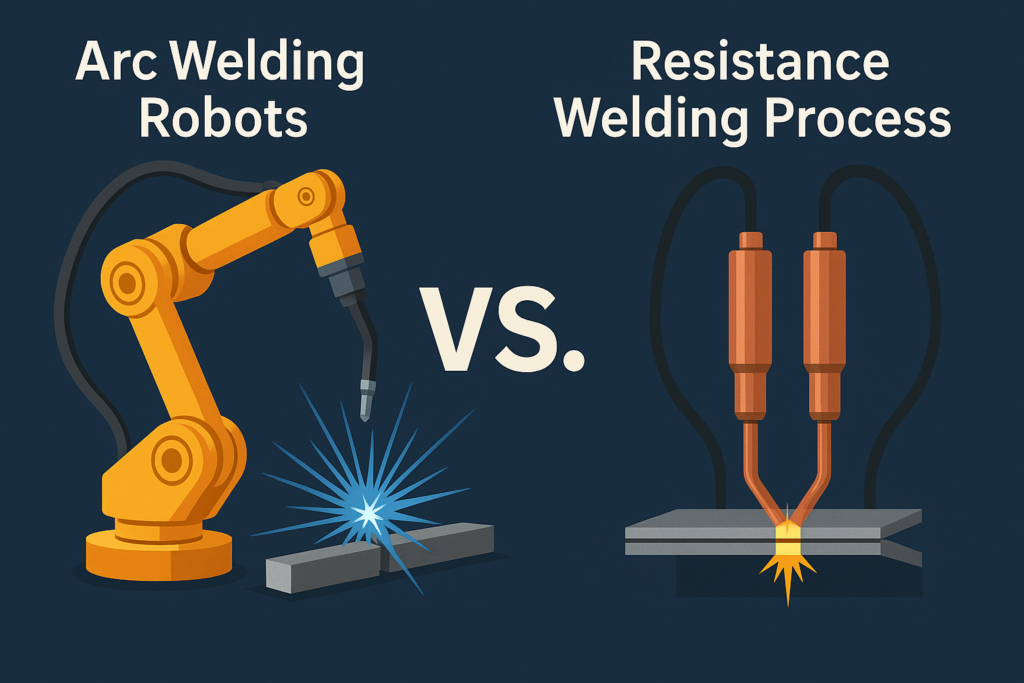
Before we jump on the topic, “Arc Welding Robots vs. Resistance Welding Process”, let us be clear about what they are exactly and how they can be helpful for your industrial work.
Arc Welding Robots
Almost 20 percent of the total welding applications are covered by arc welding robots. While different types of processes fall under arc welding, they rely on the constant connection of metals with electricity. A power supply produces the energy necessary for creating an electric arc between the electrode and the base metal. The electric arc generates the heat required for melting the metals; once cooled, the metals fuse together.
Applications for arc welding include MIG, TIG, cored flux, and plasma welding methods. Two common welding robots for automating arc welding applications are the FANUC Arc mate 100i and the FANUC Arc mate 120i series.
Depending on the specific type of arc welding application, either a consumable or non-consumable electrode is used. Some arc methods require the use of filler metals, while others do not. Because arc welding involves consumables, all robotic arc welding processes tend to have higher associated costs.
Other drawbacks for arc welding include longer processing time, the need for workpiece surface finishing, and potential hazards. Slag often forms at joints due to flux, which must be cleaned with post-weld finishing. Intense arc light and excessive heat pose additional risks. Using robots like the FANUC Arc mate 120iC in a properly enclosed welding cell helps mitigate operator exposure to these hazards — but safety precautions remain essential.
Nevertheless, arc welding offers significant flexibility: a wide range of metals can be welded regardless of thickness or position. Arc welding is ideal when working with thicker metals or dissimilar metal combinations, and it produces very durable welds.